

Year-End Family Reflection: A Guided Talk for Parents & Kids
As the year winds down, many families begin thinking about connection, communication, and the overall emotional health of the home—much like the goals of strengthening healthy family relationships. By the time December rolls around, most families feel a mix of relief and chaos. School schedules shift, work ramps up, and everyone carries a little extra tiredness.
That’s why a year-end reflection doesn’t need to look like a serious sit-down meeting. It can feel more like a warm pause together. Think of this as a gentle reset, not a performance. You don’t need fancy supplies or a perfect mood. You just need a little time, a calm moment, and a willingness to be real.
When you intentionally slow down—something often encouraged in family counseling—you create space for kids to talk more openly. And when you pair reflection with family bonding activities, kids stay engaged, and parents feel less pressure to “get it right.” Set aside 20–30 minutes. Put phones away. Grab hot chocolate, sit on the couch, or even do this during a slow car ride. The setting matters way less than the vibe: safe, curious, and connected.
Why Activities for Family Bonding Matter Right Now
Kids don’t always open up because you ask a great question. They open up because they feel steady with you. That steadiness grows through shared moments, especially small ones.
Activities like drawing, building, walking, or baking help family bonding that gives your child a low-pressure way to be with you. When minds relax, that’s when real conversation sneaks in. Year-end reflection works the same way. If you only talk, your child might freeze up. If you talk while doing something simple together, they relax into it.
So instead of “Let’s have a talk,” try:
- “Want to help me make a snack and chat for a bit?”
- “Let’s do a quick year recap while we color.”
- “Come with me on a walk. I want to hear about your year.”
You’re not bribing them into connection. You’re meeting them where they already feel safe.
Spot the Bright Moments in Your Parent-Child Relationship
Start with what went well. Kids often expect adults to focus on what needs fixing, so leading with positives sets the tone. And you don’t need to force big highlights. Tiny moments count.
Try prompts like:
- “What was your favorite thing we did together this year?”
- “When did you feel proud of yourself?”
- “What made you laugh really hard?”
- “What’s something you learned about yourself?”
Then add your own reflections about the parent-child relationship:
- “I loved watching you try new things, even when you felt nervous.”
- “I noticed how kind you were to your friends.”
- “I felt closest to you when we played that silly game in the kitchen.”
Keep it specific. Kids trust your words more when they sound real and grounded in actual moments.
Gentle Parent Talking to Child About the Highs
Once you name a few bright spots, lean into them. This keeps the conversation hopeful and helps your child see their own growth.
A simple structure helps:
- Name the moment. “Remember when you…”
- Name the feeling. “I felt proud / happy / amazed.”
- Name the strength. “That showed your courage / kindness / patience.”
Example:
“Remember when you tried out for the team even though you felt scared? I felt so proud watching you walk in there. You showed real courage.”
This style of parental talking helps because it does two things at once: it celebrates the child and connects you to them emotionally. If your child shares something they love, don’t rush past it. Ask one more question:
- “What made that so fun for you?”
- “What part do you hope we do again next year?”
You’re teaching them to notice happiness, not just chase it.
Honest Parent Talking to Child About the Hard Stuff
After positives, you can gently open space for the tough parts. If you go straight into challenges, kids may brace themselves. But after having shared warmth, they’re more likely to trust the moment.
Try:
- “What was something that felt hard this year?”
- “Was there a time you felt lonely or upset?”
- “What do you wish had gone differently?”
Then listen without fixing it right away. Kids don’t need a solution in the first 10 seconds. They need to feel heard.
Responses that help:
- “That makes sense.”
- “I’m glad you told me.”
- “Tell me more.”
- “What was that like for you?”
If they share something about you (it happens), keep your footing. You can say: “Thank you for telling me. I didn’t realize that it hurt you. I want to do better.”
That's a powerful parent talking to a child. You model repair, not perfection.
Simple Family Bonding Activities During the Talk
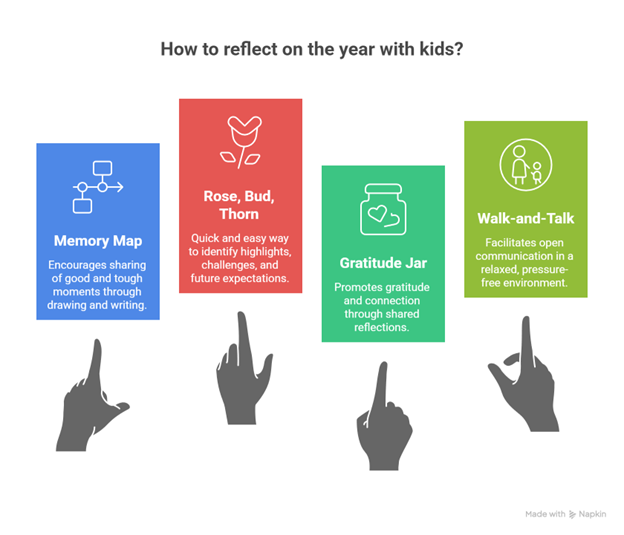
Here are a few easy options that help kids stay open while you reflect:
1. Memory map
Grab paper. Draw a simple timeline of the year. Mark months or seasons. Each of you writes or draws one good moment and one tough moment. Share as you go.
2. Rose, bud, thorn
Rose = favorite part of the year.
Thorn = hardest part.
Bud = something you’re looking forward to.
This takes 10 minutes and works for any age.
3. Gratitude jar
Everyone writes 2–3 things they’re grateful for about the year and drops them in a jar. Read them out loud. Let it get a little silly or sweet. Both count as connection.
4. Walk-and-talk
No supplies, no pressure. Just a slow walk around the neighborhood. Kids talk better side-by-side than face-to-face sometimes.
These family bonding activities keep the reflection light enough for kids while still meaningful enough for parents.
Build Next Year with Activities for Family Bonding
Now shifts toward the future. Keep it simple and hopeful. You’re not writing a five-year plan. You’re choosing how you want to feel together.
Ask:
- “What’s one thing we should do more next year?”
- “What’s a family tradition you want to start or keep?”
- “How do you want our home to feel?”
Then brainstorm activities for family bonding that match those feelings:
- If you want more calm: weekly movie night, Sunday pancakes, quiet bedtime chats.
- If you want more fun: game nights, backyard campouts, cooking a new meal together once a month.
- If you want more support: a 10-minute check-in every Friday where everyone shares a high and low.
Let your child pick at least one idea. Ownership builds excitement, and excitement builds follow-through.
Grow Your Parent-Child Relationship with a Yearly Ritual
Here’s the real secret: the talk matters, but the ritual matters more. When kids know they’ll get this space with you every year, they start trusting the relationship in a deeper way.
A yearly reflection says:“We belong to each other.”
“We can talk about real things.”
“We can celebrate and repair.”
That’s the heartbeat of a healthy parent-child relationship.
Keep it doable. Keep it kind. If the conversation wanders, let it. If someone gets emotional, stay close. If your child shrugs through half of it, you still planted something good. Connection grows over time, not in one perfect night.
Final Thought
A year-end reflection doesn’t require big plans or structured questions. Sometimes quiet, honest conversations are the ones kids remember most. It needs you to be more present, warm, and willing to listen. When you pair a steady parent talking to a child with a few simple family bonding activities, you give your family something better than a recap. You give them a memory of being known and listened to.
And if your family is hoping to strengthen communication, rebuild connections, or create healthier patterns going into the new year, this kind of gentle check-in is already a meaningful step. Sometimes families discover that conversations like these open the door to deeper healing or supporting family therapy can help guide with care and understanding. Our licensed therapists at Texas Online Counseling provide family and parent-child counseling designed to strengthen relationships and support every member of your home.
And as you step into a new year, this small ritual of pausing, listening, and reconnecting can become one of the most meaningful traditions your family builds together.
