
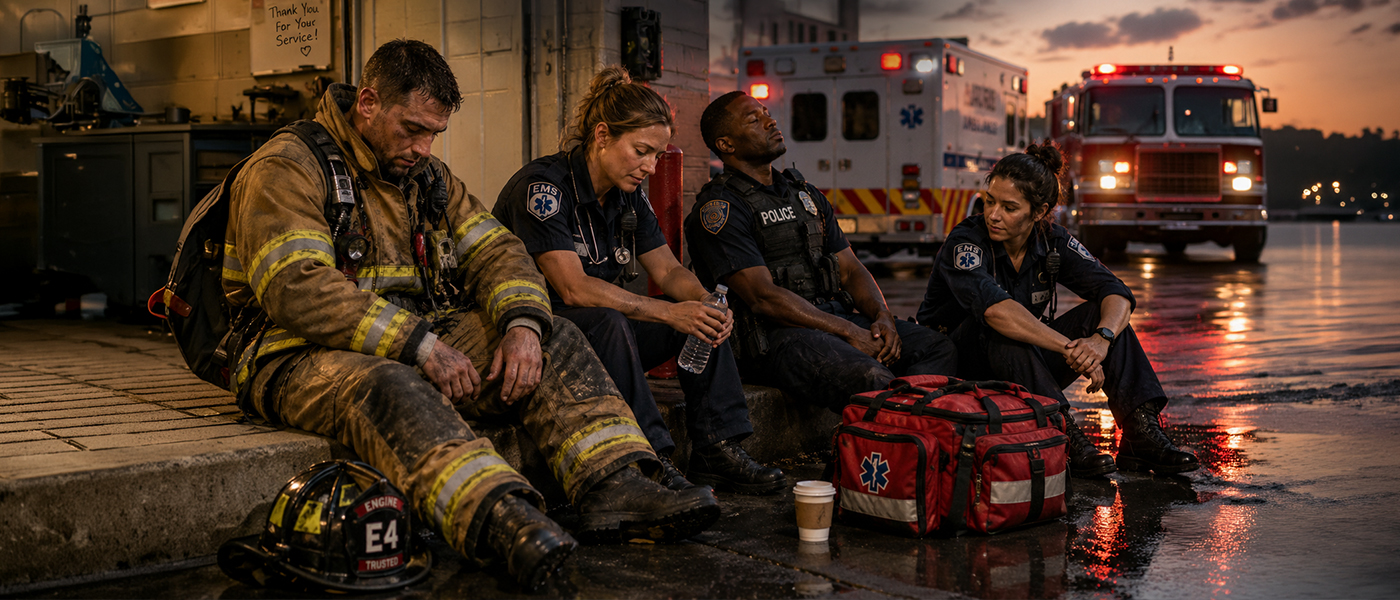
Effective Decompression Techniques for First Responders After a Tough Shift
First responders save lives daily. They are under tremendous emotional stress. Each shift ends, and the person goes to rest. However, is it so easy to shake off the weight of a stressful day? Police officers, firefighters, paramedics, and emergency medical technicians all face the same effect. What these people see, hear, and feel at work haunts them at home. How can you overcome this effect? How can you effectively relax after a tough shift? The lives of others often depend on the mental state of these employees. We offer you one of the most powerful tools for protecting your long-term mental health.
In this guide, we've examined scientifically proven relaxation techniques developed specifically for emergency services workers. We'll explain why the nervous system resists shutting down after working under high stress and how online therapy for first responders can help you regain your calm, relax, and return to your important work with renewed vigor.
Why Your Body Won't Just ‘Switch Off’ After a Shift
When you respond to an emergency, your body activates the stress response. It releases adrenaline and cortisol to keep you alert, focused, and ready for action. These hormones don't disappear the moment you leave the scene. They can keep your nervous system in a heightened state of alert for several hours after the call ends.
Psychologists call this "controlled stress reduction." Without it, the stress cycle never fully resolves. A person remains in a state of chronic heightened arousal. For example, you may be physically present at home, but mentally still at the scene.
This human response is shaped by biology, operational culture, and years spent in high-risk environments.
One traumatic call can be survivable. However, the gradual accumulation of negative experiences over months and years leads to cumulative trauma. This wears down emergency responders over time. 85% of emergency service personnel experience symptoms related to mental health issues. Depression and post-traumatic stress disorder are five times more common in this population than in the general population. Mental health for first responders requires special attention.
PTSD in First Responders
In Table 1 below, we compared PTSD prevalence rates across various occupational groups based on peer-reviewed studies. We included a 2025 systematic meta-analysis published in ScienceDirect and national SAMHSA data. (*Review, PMC 2022; rates reflect studies with broader criteria.)
| Occupational Group | PTSD Prevalence Range | Vs. General Population |
| General Public | ~3.6–5% per year | Baseline |
| Police Officers | 11–17% | 3–5× higher |
| EMTs / Paramedics | 11–15% | 3–4× higher |
| Firefighters | Up to 57%* | Up to 11× higher |
| All First Responders (avg.) | 10–23.2% | 2–5× higher |
Sources: ScienceDirect 2025 meta-analysis; SAMHSA; Journal of Advanced Nursing 2023; PMC 2022 scoping review.
The Three-Phase Decompression Protocol
Effective recovery after a shift goes through three distinct phases. Trying to immediately "relax" and skip the previous phases leads many emergency services workers to feel agitated even after just a few hours at home.
Phase 1: Discharge (Burn Off Adrenaline)
Physical activity after a sharp rise in adrenaline is biologically necessary. Exercise burns off residual stress hormones and restructures the nervous system, allowing gentler calming techniques to take effect. Running, swimming, working out at the gym, or even a brisk 20-minute walk are all suitable.
Phase 2: Transition (Create a Psychological Boundary)
Transition rituals signal to the brain that the threat has passed. They don't have to be complicated. Changing out of uniform, washing up, choosing a specific route home, or driving quietly in the car for ten minutes before entering the house can help you calm down. Be consistent. A repetitive routine trains the brain to automatically switch to a reduced-stress mode.
At this stage, use two simple and effective techniques:
- Square breathing. Inhale for 4 seconds, hold for 4 seconds, exhale for 4 seconds, hold for 4 seconds. Repeat four to six cycles. This activates the parasympathetic nervous system and lowers your heart rate for several minutes.
- Digital boundary. Put away work phones and avoid checking on-call messages for at least 30 minutes after your shift ends. Constant communication keeps the brain in work mode, even at home.
Phase 3. Restore (Rebuild and Process)
How to recover? Do activities to replenish your emotional reserves. Talking to family or a trusted friend, journaling two or three key thoughts that arose during your shift, reading, listening to music, or practicing mindfulness can help. Apps like Headspace and Calm offer coached sessions for high-stress professions.
Coworker support is also important. Structured or informal conversations with colleagues who share the same operational culture are among the most culturally appropriate ways to protect against the accumulation of trauma.
For your convenience, this table summarizes the core decompression techniques with practical implementation guidance and the evidence rationale behind each.
| Technique | What to Do | Why It Works |
| Box Breathing (4-4-4-4) | Inhale 4 sec → Hold 4 sec → Exhale 4 sec → Hold 4 sec. Repeat 4–6 cycles. | Activates the parasympathetic nervous system; lowers cortisol and heart rate within minutes. |
| Physical Exercise | Run, swim, go to the gym, or do yoga for 20–30 min immediately after your shift. | Burns residual adrenaline and resets neurochemistry before softer calming is possible. |
| Transition Ritual | Change clothes, wash face, take a brief drive or walk—a consistent end-of-shift cue. | Consistent routines train the brain to down-regulate from high-alert states (NIH). |
| Mental Download / Journaling | Write 2–3 key thoughts or moments from the shift in a private notebook. | Externalizes rumination, allowing the brain to 'file away' the shift rather than replay it. |
| Peer Check-In | Ask a colleague 'How are you holding up?' and actually listen. 5-minute debrief after tough calls. | Peer support normalizes emotional responses and is culturally accepted within FR culture. |
| Digital Boundaries | Put away work phones; no email for 30+ minutes after the shift ends. | Constant connection keeps the brain in work mode even when physically home. |
| Professional Counseling (CBT / EMDR) | Schedule regular sessions with therapists for first responders. | Evidence-based therapies treat PTSD, depression, and co-occurring substance use—beyond self-care capacity. |
What Not to Do After a Tough Shift
The Alcohol Trap
Emergency responders often resort to alcohol for self-medication. Unfortunately, this is extremely harmful. Approximately 50% of firefighters report current excessive alcohol use. Alcohol may blunt the immediate stress response, but it disrupts sleep patterns and increases anxiety the next day. Over time, alcohol significantly increases the risk of developing a substance use disorder.
Nancy Blum, a Licensed Professional Counselor (LPC-S) at Texas Online Counseling, specializes in counseling emergency responders and substance abuse issues. This dual specialization allows her to provide effective support.
Isolation
Isolation from family, friends, and colleagues may seem protective, but it actually accelerates the accumulation of traumatic experiences. The National Alliance on Mental Illness notes that emotional consequences accumulate when people absorb stress without sufficient time to recover. Isolation simultaneously eliminates all avenues to recovery.
When Decompression Isn’t Enough
Self-help techniques help manage everyday stress. They do not treat post-traumatic stress disorder, clinical depression, or substance use disorders. It is important to transition from self-help to professional therapy for first responders.
Contact a certified counselor for first responders if you notice any of the following symptoms persisting for more than two weeks:
- Intrusive memories or nightmares related to specific calls
- Persistent irritability, angry outbursts, or emotional detachment
- Difficulty concentrating or making decisions while on duty
- Social isolation from family, friends, or coworkers
- Increased use of alcohol, medications, or other substances to relieve stress
- Thoughts of self-harm or that others would be better off without you.
The Stigma Barrier and Why Online First Responder Therapy Changes Everything
57% of emergency responders fear negative career consequences if they seek help, and 74% fear demotion or dismissal. A culture of stoicism, characterized by "not showing weakness," is one of the most significant barriers to early intervention. Online first responder therapy removes this most obvious barrier, helping them be seen and feel accepted.
Telemedicine provides confidential mental health support from the personal space of the emergency responder's choosing. There are no waiting rooms, no colleagues in the parking lot, and no scheduling issues. Confidentiality is built into the concept itself.
Counseling for First Responders with Nancy Blum
Nancy Blum, MS, LPC-S, CRC, CCM

Nancy Blum has over 20 years of experience. She is a licensed professional counselor-supervisor and certified rehabilitation counselor, specializing in therapy for emergency responders, post-traumatic stress disorder, anxiety, depression, grief, anger management, and substance abuse. Nancy holds a Master of Science in Psychology and Rehabilitation and is certified in cognitive behavioral therapy. Her person-centered approach combines CBT, motivational interviewing, and trauma-informed interventions. It is tailored to the unique culture and pressures faced by emergency responders. Nancy understands that seeking help takes courage, and she is willing to assist. Texas Online Counseling | Online | EAP & Insurance Accepted |
Frequently Asked Questions
What is a Certified Emergency Services Counselor?
This licensed mental health professional is trained in the occupational stressors, cultural norms, and traumatic experiences specific to emergency services workers. They possess the necessary skills to provide therapy to emergency services workers using evidence-based methods such as cognitive behavioral therapy and eye movement desensitization and reprocessing without requiring the worker to justify their actions or explain their professional culture.
Is online therapy effective for PTSD in emergency services workers?
Yes. Telehealth provides results comparable to in-person therapy for PTSD, depression, and anxiety. For emergency services workers, online therapy removes barriers associated with stigma, making it clinically more accessible and effective for this population.
How do I know if I need therapy or if self-help is sufficient?
If decompression techniques provide relief within a few days, then self-help is working. If symptoms persist, worsen, or begin to interfere with your work, relationships, or sleep for more than two weeks, consider professional counseling for first responders. Early intervention consistently yields better results than waiting until symptoms become severe.
Does Texas Online Counseling accept insurance?
Yes. Texas Online Counseling accepts cash payments, employee assistance programs, and partners with insurance companies to ensure therapy is affordable for first responders. Contact our first responder therapist to confirm your specific insurance coverage.
Decompression is not a weakness. It Is Operational Readiness.
Your dedication makes you exceptional at the scene. Your vigilance, composure, and desire to protect others help you be a highly effective specialist. This makes decompression essential. Your nervous system never fully recovers. This leads to negative consequences for your health, family relationships, and professional performance. Breathing exercises, peer support, and exercise are your essential tools. A certified first responder counselor will support you when these tools reach their limits.
You protect your community every shift. It's time to protect yourself. Schedule a confidential tele-counseling session with Texas Online Counseling today.
